


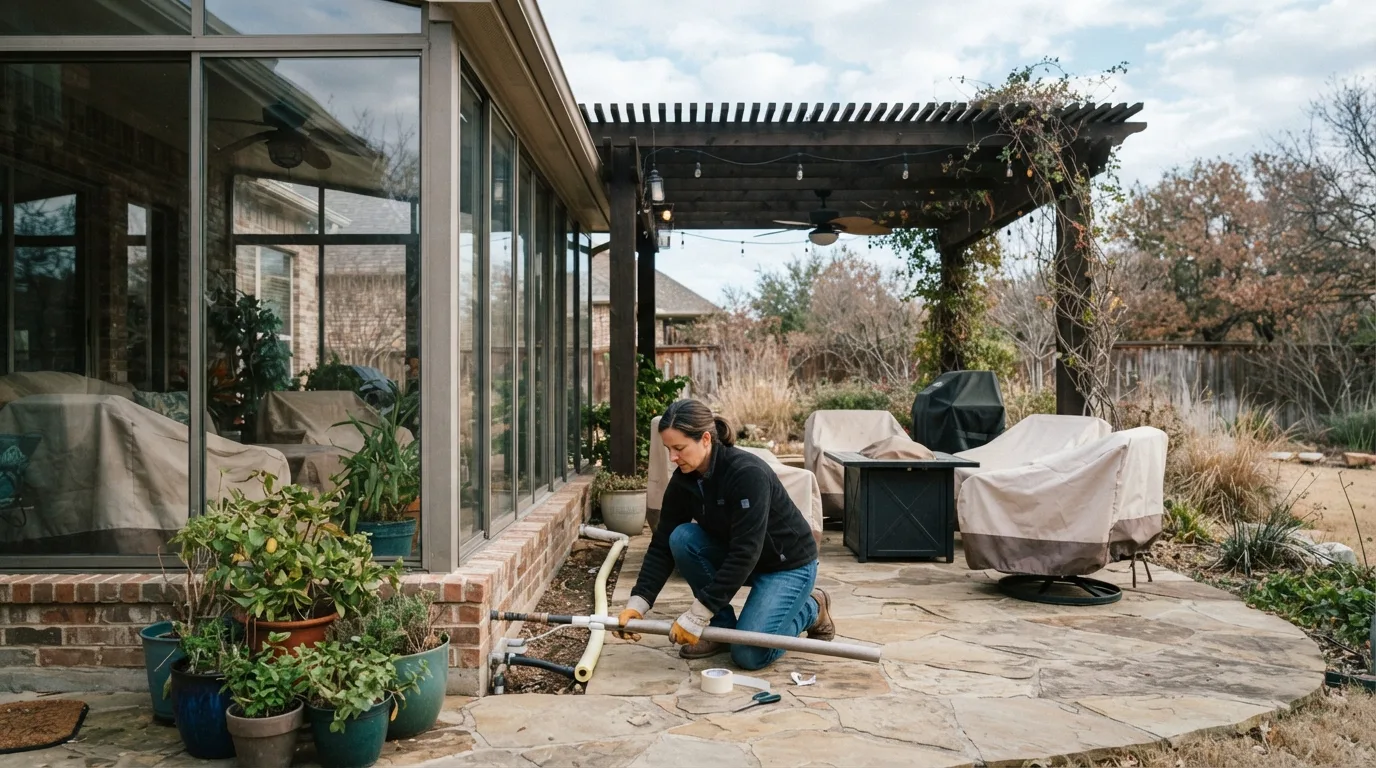
Will a hard freeze damage my sunroom, patio cover or pergola?
Usually not, if you take a few minutes to look things over before the cold arrives. A freeze tends to expose existing weak spots rather than create new ones. A short walk-around will show you what needs attention.
Start where the structure meets your house, since that connection is where water and air most often get in. Look for cracked or missing sealant, gaps you can see daylight through, and weatherstripping that has pulled away. Then work outward:
- Glass and frames (sunrooms): Look for cracks, especially near the edges of panes. Check the frame corners for gaps or separation. Fogged glass between panes can wait; it does not need action before winter.
- Drainage: Clear leaves from gutters and downspouts, and make sure water runs away from the structure. On roof panels or the patio slab, note any spot where water still stands about a day after rain. Pooling that lasts that long deserves a closer look.
- Fasteners and moving parts: On patio covers and pergolas, confirm that brackets and screws are snug. Give each post or beam a gentle push. If something shifts by hand, mark it. On operable pergola louvers, make sure the slats still open and close freely.
- Screens and solar screens: Check that screen frames sit square and that panels fit securely. Loose panels can be removed or tightened before a cold front.
- Four-season rooms: Confirm that heating and cooling vents inside the room are open and that the thermostat is set. If any plumbing or AC lines run through unheated areas, check that they are insulated.
For the walk-around itself, you only need a flashlight, a notebook or phone for photos, and a stable stepladder if you need one. Keep the inspection on the ground or on a safe ladder with someone nearby. Do not climb onto roof panels or lean on glass. For anything above ground level, a professional check is the safer choice.
Write down what you find in three groups: cracked (glass, panels, or sealant that has failed), loose (anything that moves by hand), and pooling (water that stays put after rain). Photos help when you call for advice.
Over 31 years and roughly 10,000 installations across North Texas, these are the places our crews look first. Most items on a list like this are minor and inexpensive to fix. If your notes show something larger, or you would simply like a second set of eyes, call us at (972) 243-5390 or request a free design consultation and quote at sunshinesunrooms.com.
Sunroom Checks Before the First Hard Freeze
A few minutes of inspection before cold weather can catch small problems while they're still easy to fix. Work through the list below in order. The first items matter most.
1. Glass panes and seals (check first)
- Look for: cracks, chips, and fogging or moisture trapped between the layers of double-pane glass. Check the corners and edges, where cracks often start.
- Good looks like: clear glass, no cracks, and no haze or droplets between panes.
- If it's bad: Fogging means the factory seal between the panes has failed. The insulating value is gone, though the glass itself is still safe. A crack, especially one that runs from an edge or is growing, should be checked before a freeze, since cold temperatures and ice can make it spread. Call for service if you see either.
2. Roof-to-wall and door junctions
- Look for: gaps, cracked or peeling sealant, and flashing or trim that has pulled away from the wall or roof. Press gently along the edges. Look for daylight, damp spots, or stains on the ceiling and walls near these joints.
- Good looks like: sealant that is flexible and fully bonded, with no daylight showing and trim that doesn't move.
- If it's bad: Note the location and call for repair. Don't try to pack a large gap with caulk yourself. Sealant needs warm, dry conditions to cure properly, so wait for a mild day and don't apply it when temperatures are near freezing.
3. Window and door tracks
- Look for: debris and leaves in the tracks, and small weep holes at the bottom of the frames.
- Good looks like: tracks are clear and weep holes are open, so water can drain out instead of pooling.
- If it's bad: Vacuum the tracks, and clear the weep holes with a soft brush or a thin plastic tool. Don't use metal tools that could scratch the frame.
4. Water paths: roof, gutters, and grade
- Look for: gutters and downspouts that are full or disconnected, roof areas where water pools or runs toward the room, and water collecting at the base of the walls.
- Good looks like: gutters are clear, downspouts carry water at least several feet away from the foundation, and the ground slopes away from the room.
- If it's bad: Clean out debris, reattach any loose downspouts, and extend them away from the room if needed. Standing water against the walls or a slope that runs toward the room should be addressed before a freeze. A grading contractor or your sunroom installer can advise on fixes.
5. Thresholds and floor edges
- Look for: water stains, soft spots, or gaps where the floor meets the outside.
- Good looks like: dry, firm flooring and no daylight under the door.
- If it's bad: Water getting under a threshold is a call-now item, because it can freeze and cause further damage.
Four-season vs. three-season rooms: If your room is insulated and heated or cooled for year-round use, check the HVAC vents, thermostat, and any electrical connections as well. Make sure the heat works before the first cold night. Three-season rooms aren't built for winter, so consider draining exterior hose bibs and moving or covering furniture that could be damaged by cold.
Safety note: Don't climb onto a roof or ladder on icy or wet surfaces. If a check requires reaching high areas, have someone assist you or call a professional.
When to call a pro: Get professional help for any cracked glass, fogged panes, water inside the room, sealant or flashing that has pulled away, or drainage that runs toward the foundation.
Sunshine Sunrooms has been serving Dallas-Fort Worth homeowners since 1993. We repair sunrooms regardless of who built them or how old they are, and we're happy to inspect your room before the cold arrives. Call (972) 243-5390 or visit sunshinesunrooms.com to request a free consultation.
Patio Cover Roofs, Gutters and Where the Water Goes
Before a North Texas freeze, a few simple checks can prevent most of the trouble a patio cover causes in winter. Start with the roof. Clear leaves, twigs, pollen and any debris that has collected in the low spots of the panels or along the flashing where the cover meets the house. If you need a ladder to do this, have someone steady it, and never work on a wet or icy surface.
Next, check the gutters. Look for sagging sections, gaps at seams and end caps, and hangers that have pulled loose from the fascia. Run a hose through the gutter and watch where the water goes. If it stands in one spot or drips at a seam, the gutter may be out of level or a joint may be failing. Fix that before cold weather. Water that freezes in a gutter expands and can split the seam or pull the hanger away.
Downspouts are where many winter problems begin. Make sure each one is clear from top to bottom, including the elbow at the bottom of the run, which tends to collect debris. Water should exit the downspout and travel at least several feet away from the house and the slab. A short extension or splash block works well for this. A downspout that dumps water at the foundation or right next to the patio will send that water toward the slab, where it can freeze.
Runoff is the homeowner's real cold-weather risk. Water that runs off a patio cover and pools on the concrete will freeze into a slick, uneven surface overnight. It can also seep under the slab edge or against the wall of the house. Walk the perimeter after a rain and note where water collects. Low spots near the patio edge may need a change in how the downspouts discharge, or a minor grading correction.
Finally, look for signs of damage that point to a leak or a structural problem. Watch for loose or missing fasteners on the panels, gaps in the sealant where the cover attaches to the house, bent or shifted trim, sagging spans, and water stains on the ceiling or fascia underneath the cover. Hail dents count too, since they can open small paths for water. Any of these signs is a good reason to have the cover looked at before the first hard freeze, not after.
If you find anything on this list that you are not sure how to fix, we are glad to help. Sunshine Sunrooms has been serving Dallas-Fort Worth since 1993, and we repair sunrooms regardless of who installed them. You can request a free design consultation and quote at sunshinesunrooms.com, email sales@sunshinesunrooms.com, or call (972) 243-5390. We will walk through the condition of your cover and give you honest, straightforward pricing at the first visit.
Pergola Slats, Moving Parts and Anchors: Pre-Freeze Check
Aluminum pergolas need far less upkeep than wood, but they still need a look before winter. Do this check when the forecast first shows overnight temperatures near freezing, ideally on a mild afternoon.
1. Slats and roof channels
- Clear leaves and debris from the roof channels and gutters.
- Make sure the drain openings are open, so water can run off instead of pooling.
- Look along each slat for dents, bends, cracked finish or hail marks. Damaged slats can bind as they move, so note any and have them checked before a freeze.
- Check the finish for bubbling, flaking or white powder. Small marks are normal. Widespread finish failure is worth a professional opinion.
2. Moving parts (louvers and mechanisms)
- Open and close the louvers by hand or remote while the air is still mild. A healthy louver moves smoothly and holds its position without drifting.
- A binding louver feels gritty, catches at one point in its travel, or moves unevenly from one side to the other. Stop there. Do not force it.
- Never force a roof mechanism that is frozen or iced. Wait for it to thaw. Pressing the remote repeatedly can overheat the motor or drain the battery.
- Motorized louvers: switch off power at the breaker or disconnect before you inspect near the motor or linkage. Replace remote batteries if the louvers respond slowly.
- Pivot points: check your owner's manual for lubrication instructions. Many aluminum pivots need no lubricant at all. If your manual calls for one, use only the product it specifies. Some lubricants attract grit or damage finishes.
- Set louver position according to the manufacturer's cold-weather guidance. Ask us if you are unsure how your model should be positioned.
3. Anchors and fasteners
- Freestanding posts: Check each post base for tight bolts and look for cracks or chips in the concrete footing. Look for gaps or soil washing away at the base.
- Slab-mounted posts: Confirm base plates sit flat with no rocking or movement. Look for rust streaks or corrosion at the bolts.
- House-attached pergolas: Check the ledger or wall brackets and their lag screws or bolts. Look for gaps between the bracket and the house, or any wood that feels soft near the fasteners.
- Deck-mounted posts: Check that the post base bolts are tight and that the deck boards around them are not soft or rotting.
- Gently push each post and beam. Any movement at a connection, or a fastener that spins without tightening, needs attention before winter.
When to stop and call a professional
- A louver that binds, grinds or will not move
- Cracked, bent or sagging members
- Post or bracket movement, or a loose anchor
- Corrosion or staining at a connection point
- Any motor or electrical problem
Our team can inspect your pergola and give you an honest quote at the first visit. To request a free design consultation and quote, call (972) 243-5390, email sales@sunshinesunrooms.com, or visit sunshinesunrooms.com. Sunshine Sunrooms, 2410 Glenda Lane, Dallas, TX 75229.
After a Hard Freeze: What to Check and When to Stop
Start with safety. Stay off the roof and don't stand under any sagging panel or cover. Don't push on posts, beams or connections to test them. If anything looks bent, cracked or out of place, look from a safe distance and stop there. Keep clear of any fixtures, outlets or wiring, and don't touch them if they are wet.
Stop and call a qualified contractor if you see any of these:
- Roof panels or a cover that sag, bow or pull away from the frame
- A post base that is lifted, shifted or sitting on a different spot than before
- Cracked glass or glazing overhead, or a pane that has come loose
- Water near light fixtures, ceiling fans, outlets or AC equipment
- A gap that is widening where the structure meets the house
- A door or window that won't close at all or has jammed
If none of those apply, you can continue with a visual check.
Inside the house. Look at ceilings and walls next to the sunroom or patio for new stains, soft drywall or damp smells. Check the attic space above and the flooring or baseboards along the wall where the structure attaches. Water damage often shows up after the thaw, not during the freeze, so check again over the next few days. Photograph anything you find and note the date.
The roof and cover. From the ground, look for new cracks in panels, separated seams, or dents where ice or debris landed. Check flashing and caulk lines where the roof meets the house. Gaps or cracked sealant there are common paths for water, so note them even if the area looks dry today. On pergolas, check that slats or louvers still move freely and sit straight.
Glass and screens. A milky fog trapped between the panes of a double-pane unit usually means the seal has failed. Condensation on the surface, by contrast, wipes off or clears as the glass warms. On screen rooms, look for torn mesh, bent frames or panels that no longer seat properly.
Doors and windows. Open and close each one fully. If a door drags, rubs or won't latch cleanly, the frame may have shifted. Note it, and don't force it.
Gutters and drainage. Check for sagging gutters, detached downspouts or standing water near the posts. Ice that backs up in gutters can push water under the roof edge.
Once you've finished the visual check, write down what you found, with dates and photos. That record helps whoever comes to look at it. If you are unsure what you are seeing, or if anything from the stop list is present, have it looked at by a qualified professional before the structure is used again.
Sunshine Sunrooms repairs sunrooms regardless of who installed them or how old they are, including leaks, fogged glass, structural separation, door and window problems, and damage from storms or ice. To schedule an inspection, call (972) 243-5390 or visit sunshinesunrooms.com.
Match the structure to how you want to use the space
Choosing between a sunroom, a patio cover and a pergola comes down to one question: how do you want to spend time outside, and in which months? Each structure supports a different kind of use.
A four-season sunroom is a room you use all year. It is fully insulated and connected to heating and cooling, so it works for daily breakfasts, a home office with a view, or evenings with the family in January. It also adds true living space to your home.
A three-season sunroom is a room for spring through fall. It has large windows or sliding panels that open the space to the breeze, and it keeps the yard close without the heat and bugs of an open patio. It does not hold winter warmth, so plan on it for most of the year rather than the coldest months.
A patio cover is an open-air space with a solid roof. It blocks sun and rain, so it suits weekend cookouts, outdoor dining and entertaining in any weather. Because it has no walls, insects and Texas heat still reach you, though solar screens or a fully covered style can reduce both.
A pergola is for shade and definition, not weather protection. Its open roof of beams and rafters casts partial shade and marks out a spot for seating or a garden corner. It will not keep out rain or insects. Our aluminum pergolas, with curved lattice roofs for UV protection, need no annual painting or staining.
If insects are your main frustration, a screen room gives you a bug-free space at a lower cost than a full sunroom. Its panels can be replaced individually, and it can later be upgraded to a sunroom with insulated glass.
To decide, consider these factors:
- Use: Year-round living favors a sunroom; shaded entertaining favors a patio cover; a defined relaxing spot favors a pergola.
- Enclosure and comfort: Enclosed rooms protect from insects and weather but cost more to build and cool or heat.
- Permanence and upgrades: A screen room or patio cover can grow into a sunroom later.
- Permits: Local building codes apply to most of these structures, and we handle permits as part of the project.
Every structure we build is custom-designed for your home. We do not sell prefab kits. If you are not sure which fits your yard and your routine, request a free design consultation and we will walk through your options with real pricing at the first visit. If you already know you want a solid roof over an existing patio, our custom patio covers are built for shade and rain protection.
Choosing Your Next Step
Noticed a leak, fogged or cracked glass, hail damage, structural cracks or separation, or doors and windows that no longer close properly? Call us about a repair. We fix any sunroom, no matter who installed it or how old it is. Tell us what you're seeing, and we'll explain what the repair involves.
If your sunroom is in good shape and you're considering a new space instead, whether that's a patio cover, a screen room or a kitchen or bath update, request a free design consultation and quote. A designer will visit your home and present real pricing during that first visit. You'll know your options before you decide anything.
We've served Dallas-Fort Worth since 1993, completed roughly 10,000 sunroom installations, and held Home Repair License #24277 with a BBB A rating since 1994.
Call (972) 243-5390 or email sales@sunshinesunrooms.com. Tell us whether you need a repair or a design consultation, and we'll take it from there.


