


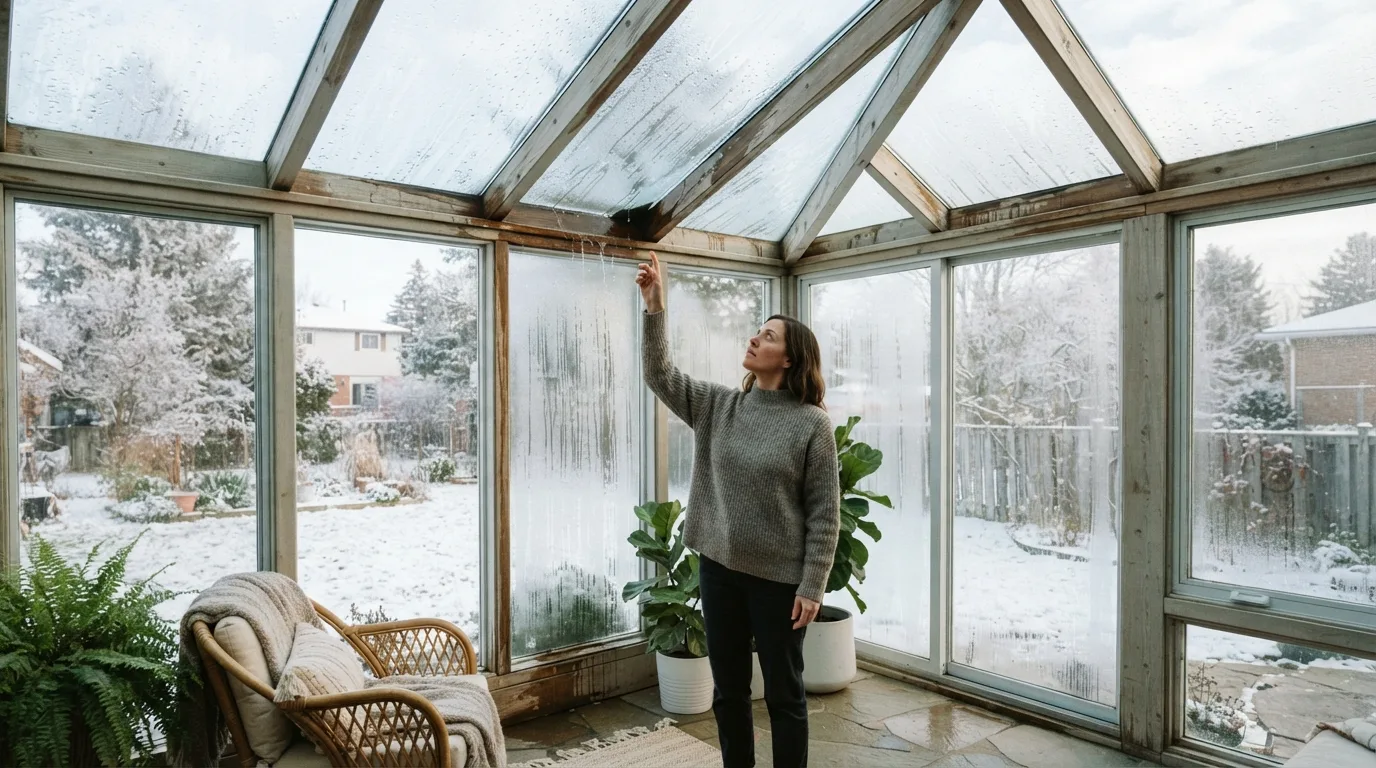
Key Takeaways
Winter moisture in a sunroom can come from room air, a failed glass seal, or a roof and wall leak, and each points to a different fix. This guide shows how to tell them apart with a few simple checks, when condensation is normal, and which warning signs mean a repair. If water keeps coming back, Sunshine Sunrooms can trace the source and price the repair before spring storms arrive. Call (972) 243-5390 to schedule a visit.
Why Sunrooms Sweat More in a Texas Winter
Condensation forms when warm, moist air touches a surface that’s colder than the air’s dew point. Think of a glass of iced tea on a summer porch. Your sunroom works the same way, just inside out.
Here’s what that looks like in real numbers. Air at 70°F and 45% humidity has a dew point of about 47°F. Raise the humidity to 55% and the dew point climbs to about 53°F. Any glass, frame, or roof beam colder than that will collect water.
On a 30 to 40 degree DFW night, a lot of sunroom surfaces drop below that line:
- Single-pane glass can run close to the outdoor temperature on its inside face.
- Aluminum frames and roof beams without a thermal break pull cold straight through to the interior, so they often sweat before the glass does.
- Older insulated roof panels with worn seals at the seams can create cold spots that drip at fastener lines.
North Texas makes this worse in a specific way. Our winters swing hard. A 70-degree afternoon can drop to the low 30s overnight, and Gulf moisture often rides in ahead of a cold front. Your sunroom fills with warm, humid air during the day, then the glass gets cold fast after sunset. That’s the perfect setup for a wet morning.
Indoor habits add to it. Plants, a hot tub, pets’ water bowls, drying laundry, and unvented propane or kerosene space heaters all put moisture into the air. A closed door between the house and an unheated sunroom keeps the room cold, which makes every surface more likely to sweat.
Condensation, Seal Failure, or a Leak: How to Tell the Difference
Use these checklists to narrow it down. Most homeowners can match their situation to one of them in a couple of minutes.
It’s probably condensation if:
- The water is on the room-side face of the glass and frames.
- It shows up on cold, dry mornings and is worst after sunrise.
- It wipes away, then comes back the next cold morning.
- It’s spread evenly across many panes and frames.
- Typical fix: lower the humidity, add airflow, or upgrade glass or frames if it’s chronic.
It’s probably a failed glass seal if:
- The moisture is between the two panes and can’t be wiped off.
- The glass looks cloudy or hazy all the time, no matter the weather.
- Wiping it does nothing.
- It’s limited to one or a few panes, often the sunniest ones.
- Typical fix: replace the insulated glass unit, not the whole window.
It’s probably a roof or wall leak if:
- You see ceiling stains, wall streaks, or drips at one spot.
- It shows up during rain or within a day or two after.
- It comes back in the same spot after the next rain.
- It’s in one location, often the roof-to-house joint, roof seams, or flashing.
- Typical fix: locate and reseal or reflash the failure point.
One important overlap: a leak and condensation can happen together. Water that sweats off a cold roof beam can run down to a seam and look exactly like a roof leak. And a small leak can soak insulation so that a section of ceiling stays cold and sweats more. If your answers point to more than one column, treat it as a repair question, not a humidity question.
Four Simple Tests You Can Run This Week
None of these need tools beyond a towel, some tape, and your phone.
- The dry-morning check. Pick a cold morning when it hasn’t rained for at least three days. If you still find water on the glass and frames, condensation is the main suspect. A leak needs water from outside to get in.
- The tape square test. Tape a small square of plastic wrap tightly to the inside of a wet pane overnight. If water forms on top of the plastic, it’s coming from the room air (condensation). If the glass under the plastic is wet or hazy, the moisture is in or behind the glass.
- The between-the-panes look. Clean both sides of a foggy pane. If the haze, streaks, or droplets are still there, they’re trapped between the panes. That means the seal on that insulated glass unit has failed.
- The photo log. Snap a photo of any damp spot with the date, the weather, and whether it rained. After two or three weeks, the pattern usually tells the story. It also saves time and money when a technician comes out, because they can see exactly when and where it happens.
Safety note: don’t climb onto a sunroom roof or lean on overhead glass to look for a leak. Roof panels and glass aren’t made to hold a person’s weight, and winter surfaces can be slick.
When Condensation Is a Sign Something Needs Repair
A little fog on a cold morning that clears by mid-morning is normal for many sunrooms. These easy steps often help:
- Keep the door to the house open, or run the sunroom’s heat, so surfaces stay warmer.
- Run a ceiling fan on low to keep air moving across the glass.
- Move plants away from the glass and cut back on watering in winter.
- Swap unvented fuel heaters for an electric heater.
- Run a dehumidifier during cold snaps.
But heavy, daily condensation is often a symptom of a problem that won’t fix itself. Call for a repair evaluation if you see any of these:
- Water pooling on sills or tracks that doesn’t drain. Blocked weep holes or failed track seals can send that water into the frame or floor.
- Dripping from the ceiling or roof beams. Worn seals at roof panel seams or the roof-to-house joint can let warm air reach cold metal, and they can let rain in too.
- Black spots, musty smells, or peeling paint near the glass. Ongoing moisture leads to mold and mildew. (See our guide on keeping your sunroom free of mold and mildew.)
- Fog between the panes. A failed seal won’t recover. The glass unit loses its insulating value and the haze usually spreads.
- Soft, swollen, or stained flooring along the walls.
- Condensation that’s getting worse year over year. That often points to aging seals, failing weatherstripping, or glass and frames that are no longer doing their job.
The good news is that most of these are targeted repairs. A failed glass unit can usually be replaced without replacing the whole window. Worn seams and flashing can be resealed. And depending on the frame, single-pane glass may be upgradable to insulated glass without rebuilding the room.
What a Winter Repair Visit Looks Like
Winter is when moisture problems are easiest to see, which makes it a smart time to get them diagnosed. Fixing a failed seal or seam now also means it’s closed up before spring storm season hits North Texas.
When you call Sunshine Sunrooms, here’s what to expect:
- In-home consultation. We look at the glass, frames, roof panels, seams, flashing, and drainage, and we review your photos if you have them.
- A clear answer on the source. We’ll tell you whether it’s condensation you can manage, failed glass units, a leak, or a mix.
- Targeted repair options and pricing. We fix the actual failure point. We don’t push a full replacement when a repair will do the job.
- Scheduling the work. Many fixes take a single visit. Larger structural or roof work may take a few days, and we’ll give you the timeline up front.
It doesn’t matter who built your sunroom or when. If your original installer won’t help, we will. Sunshine Sunrooms has served Dallas-Fort Worth since 1993, with about 10,000 sunroom installations and repairs, Home Repair License #24277, and BBB accreditation with an A+ rating. We serve Dallas, Fort Worth, Plano, Richardson, Lewisville, Grapevine, Euless, Coppell, Farmers Branch, The Colony, and surrounding North Texas communities.
Water inside your sunroom this winter? Call (972) 243-5390 or request a free estimate and we’ll find the source. You can also learn more about our sunroom repair services.
Frequently Asked Questions
Is condensation in my sunroom normal in winter?
Light fog on cold mornings that clears within a few hours is common, especially with single-pane glass. Heavy daily condensation, dripping, or water pooling on sills is not something to ignore.
Why is water dripping from my sunroom ceiling when it hasn’t rained?
It’s usually condensation forming on cold roof beams or panel seams, then running to a low point and dripping. Worn seals at the seams or roof-to-house joint can make it worse. If the drips happen in one spot after rain too, there’s likely a leak as well.
Can I fix fog between the panes myself?
No. Once moisture is trapped between the panes, the seal has failed. The fix is replacing that insulated glass unit, which usually doesn’t require replacing the whole window or frame.
Will a dehumidifier solve my sunroom condensation?
It helps when the cause is high indoor humidity. It won’t fix failed glass seals, a leak, or frames that conduct cold straight into the room.
Do you repair sunrooms you didn’t build?
Yes. Sunshine Sunrooms repairs sunrooms no matter who built them or when.


