


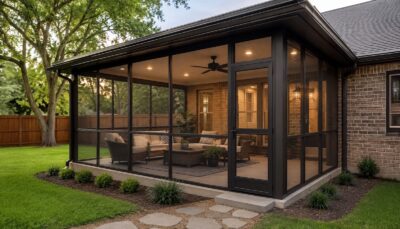
If you’ve started researching ways to add usable outdoor living space, you’ve probably run into three terms that get used almost interchangeably, screen rooms, patio enclosures, and sunrooms. They’re not the same thing, and picking the wrong one for how you actually want to use the space (and for a North Texas climate) can mean a lot of regret a year later.
Here’s how the three actually differ, and which one tends to make sense for different DFW homeowners.
Screen Rooms: Keeping the Outdoors, Losing the Bugs
A screen room is essentially your existing patio or porch enclosed with screening instead of glass or solid walls. You get airflow, shade from the roof structure, and critically for a Texas summer evening, freedom from mosquitoes without sealing the space off completely.
Best for: Homeowners who mainly want to sit outside in the evenings, spring, and fall without bug spray, and who don’t mind the space being unconditioned and closed for extreme heat or cold.
Trade-off: A screen room isn’t going to help much in July heat or a January cold snap. It extends the comfortable months, but it doesn’t make the space usable year-round.
Patio Enclosures: A Step Up in Weather Protection
A patio enclosure typically adds solid walls, windows (often with screens built in), and sometimes glass panels to an existing covered patio. It’s more weather-resistant than a screen room keeping out wind, rain, and pollen, while usually costing less than a full sunroom because it’s built onto an existing patio slab and roofline rather than requiring new structural work.
Best for: Homeowners who already have a covered patio they like and want to make it usable in more weather without a full room addition, think of it as the middle ground between a screen room and a sunroom.
Trade-off: Patio enclosures are usually not insulated to the same degree as a true sunroom, so summer heat and winter cold still limit how many months it’s genuinely comfortable without supplemental heating or cooling.
Sunrooms: A True Four-Season Room
A sunroom is a full addition, its own foundation, insulated walls and roof, energy-efficient windows, and (often) its own HVAC connection. It’s built to function as an actual room of the house, not just a protected outdoor space.
Best for: Homeowners who want a home office, playroom, workout space, or year-round living area — somewhere that needs to be comfortable in both a 100-degree August afternoon and a rare DFW ice storm.
Trade-off: It’s the most significant investment of the three, both in cost and in the permitting/construction process, since it’s treated as a true room addition by most DFW cities.
A Quick Way to Decide
Ask yourself these questions:
- Do I mainly want relief from bugs on nice evenings? → Screen room
- Do I already have a covered patio I want to make more weatherproof, without full HVAC? → Patio enclosure
- Do I want a space I can genuinely use as a room, office, gym, or den, in any season? → Sunroom
Budget matters too, and the three options do generally scale in that order: screen rooms are typically the most affordable, patio enclosures fall in the middle, and sunrooms represent the biggest investment since they’re built as full additions.
It’s Not Always One-or-the-Other
Some DFW homeowners phase this over time, starting with a screen room or patio enclosure on an existing patio, then converting or adding a true sunroom later once they know how they use the space. Others go straight to a sunroom because they already know they want year-round square footage, not just seasonal outdoor living.
Either way, the right call usually comes down to how many months a year you actually want to use the space, and what you want to use it for once it’s built.
Not sure which option fits your backyard? Sunshine Sunrooms has built screen rooms, patio enclosures, and sunrooms across Dallas, Fort Worth, Plano, McKinney, Frisco, Arlington, and the rest of the Metroplex for over 31 years. Request a free design consultation or call (972) 243-5390 — we’ll walk you through what makes sense for your space and budget.


